Fast pipelines, automated tests, and short release cycles are now standard in many development teams.
For this speed to actually work in day-to-day practice, however, more is needed than delivery processes and tooling.
What is often decisive are the foundations on which testing is based: quickly available, functionally suitable, and privacy-compliant test data.
This is exactly where a noticeable bottleneck emerges in many companies.
Not because data is fundamentally lacking, but because relevant data sets are difficult to find, functionally complex, technically distributed, and organizationally demanding to provide.
The reality of test data management
Software development is becoming faster and faster.
Features are created in short iterations, tests run automatically, and defects need to be reproduced as realistically as possible.
What is often underestimated in the process: good tests require reliable data.
In practice, however, suitable test data is rarely stored in a single, neatly prepared test database.
Instead, relevant information is spread across many tables, business objects, and often several systems.
Functionally related information such as customer, contract, claim, payment, or product reference is often technically fragmented.
Especially in mature IT landscapes, test data management quickly becomes a discipline of its own.
It is not enough to copy individual records.
What is needed is an approach that reflects business relationships and makes technical distribution manageable.
A typical insurance use case illustrates this complexity very clearly.
For example, the goal may be to find ten motor insurance contracts
- for which more than two claims were reported in the last year,
- and where the policyholder has several active contracts.
What sounds clear from a business perspective is often anything but simple technically.
In reality, such information is often stored in different tables or even in separate core systems.
A suitable search therefore has to work across systems and resolve business relationships correctly.
Where the real complexity lies
Business test cases cannot be reduced to table logic
In practice, the search for suitable test cases can rarely be solved with a single SQL query.
Business relationships often have to be taken into account, such as multiple claims within a certain period, active or terminated contractual relationships, the exclusion of special edge cases, or information that has to be consolidated from different systems.
This is exactly where a central problem of many test data processes lies: the technical data structure does not automatically reflect the view in which development, testing, and business teams work.
What is needed is not isolated table rows, but functionally consistent constellations — for example, a customer with multiple active contracts and a specific claims history.
To implement such requirements efficiently, a business abstraction layer above the technical data storage is needed.
Business objects, relationships, and cardinalities must be describable in an understandable way, even if the underlying information is distributed across many tables, interfaces, or systems.
Only then does a purely technical data search become a usable test data process.
Realistic test data is valuable — but not without risk
Production-like data has significant practical value for development and testing.
It reflects cases that an application actually has to handle in real life.
It contains not only the expected standard scenarios, but often also special constellations, historically evolved data structures, and exceptions that can easily be overlooked in design or test planning.
Data like this is especially important for reliable testing.
It helps reproduce defects more realistically, makes business edge cases visible, and allows the robustness of applications under real conditions to be assessed more effectively.
Problems often only become visible where legacy structures, incomplete data, old product logic, or unusual relationship patterns come together.
At the same time, the closer the data is to production, the greater the responsibility.
Personally identifiable or otherwise sensitive information must not enter development and test environments in an uncontrolled way.
Professional test data management therefore requires not only strong selection mechanisms, but also reliable procedures for anonymization and masking.
Consistency is especially critical here.
If data is related across multiple systems and processes, protection mechanisms must also apply across systems in a traceable way.
Rule-based modification, reusable masking logic, and deterministic methods can help provide realistic data sets without unnecessarily increasing production risk.
Test data provisioning is also an organizational process
Providing test data does not end with selecting suitable records.
In many organizations, approvals, validations, checks for sensitive content, cleanup of target environments, or downstream technical steps are also required.
This is exactly where it becomes clear that test data management is not only a technical task, but also an organizational one.
If data requests have to be reviewed manually, processes coordinated repeatedly, and follow-up activities triggered by hand, additional effort quickly arises for development, testing, operations, and business departments.
Clear workflows and automated processes can provide noticeable relief here.
This includes, for example, preliminary checks, deletion and copy processes, notifications, or technical follow-up work such as clearing caches.
The better these steps can be integrated into existing approval and operational processes, the more robust test data provisioning becomes in day-to-day work.
A possible solution approach
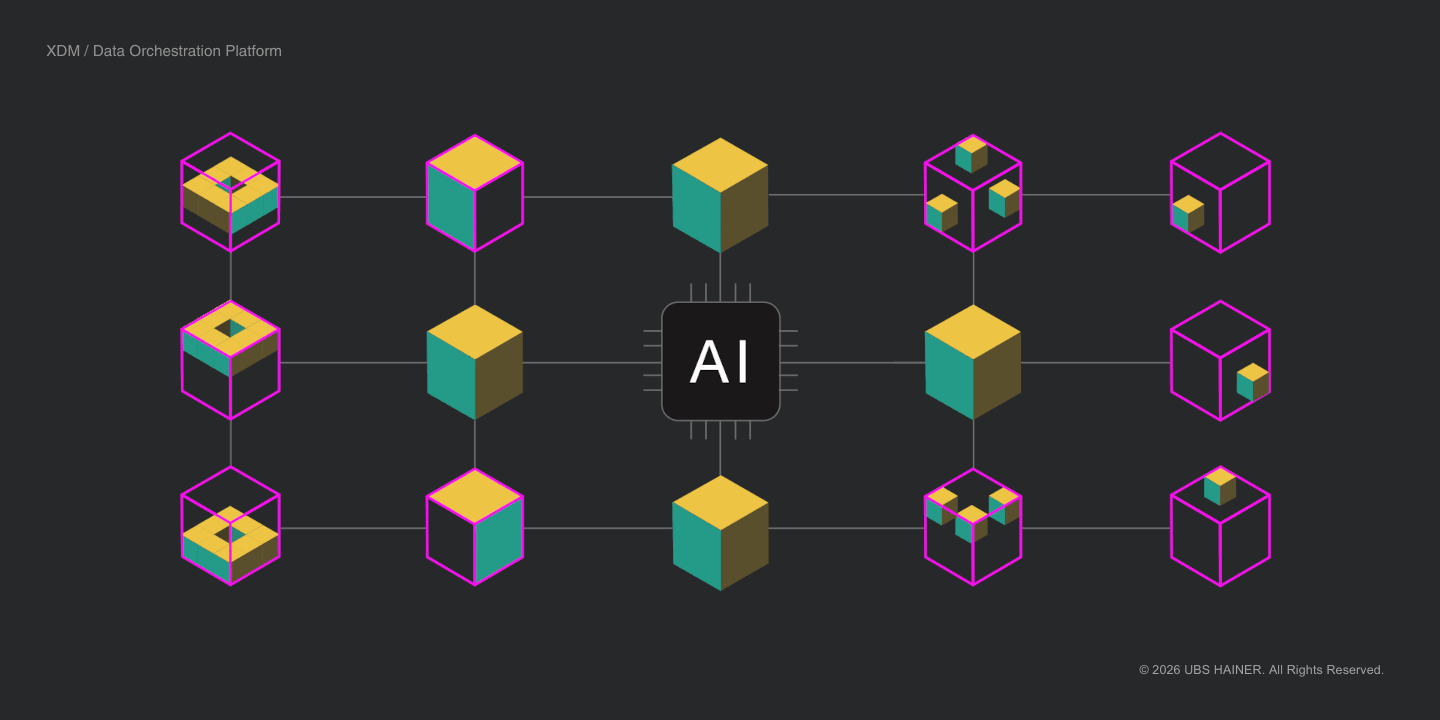
To make this complexity manageable, many cases require a platform or approach that brings several layers together: data sources, business modeling, privacy-compliant preparation, and automated provisioning.
XDM is one example of such an approach.
Applications can be modeled centrally, relationships can be described even across database boundaries, and business objects can be placed at the center.
This makes it possible not only to extract test data technically, but also to search for it based on business requirements and provide it across multiple involved systems.
For development and testing teams, this can significantly simplify access to suitable test data.
Instead of manually resolving technical dependencies in each individual case, a more structured and more standardized process emerges.
Privacy requirements and organizational approvals can also be integrated in a more controlled way.
Conclusion
In day-to-day practice, modern software development often does not fail because of a lack of ideas, but because of operational bottlenecks.
Test data is one of the topics that has long been underestimated while at the same time having a major impact on quality, speed, and reliability.
Anyone who understands test data management only as a technical copying task is usually falling short.
In practice, it involves business relationships, data privacy, system boundaries, and organizational processes at the same time.
That is exactly why a structured approach is worthwhile — one that brings these layers together and makes them more usable for teams.
If suitable test data can be provided faster, more securely, and more transparently, this does not only relieve development and testing.
It also creates more stability in processes, more confidence in decisions, and ultimately more trust in release quality.
In the upcoming second part we will look at how this model evolves further: when test data is no longer requested only through forms and processes, but directly via prompt using AI, MCP, and XDM as a shared foundation.