Db2 data masking on z/OS is more than just copy procedures. It is about the controlled, consistent, and business-ready provisioning of sensitive test data without unnecessary JCL effort.
Anyone working in a Db2 mainframe environment knows the situation: in many companies, test data is still provisioned using UNLOAD/LOAD processes, DSN1COPY, utility control, and extensive JCL workflows. This is technically proven, but often cumbersome in day-to-day operations. At the latest, when sensitive data needs to be made usable for development, testing, or analysis, simple copy procedures are usually no longer sufficient.
Because Db2 on z/OS, as well as IMS and VSAM, often contain precisely the information that requires special protection: personal data, financial information, contract data, or medical content. The real challenge is therefore not merely to copy data, but to mask it in a controlled, consistent, and business-usable way.
Why traditional mainframe copy procedures reach their limits in masking
Many mainframe teams have been working successfully with established procedures for years, such as:
- Db2 UNLOAD/LOAD
- IBM Utilities
- DSN1COPY
- Additional SORT, REXX, COBOL, or SQL steps
- Individually evolved JCL procedures
These tools are proven in operations. However, as soon as masked test data is required, complexity increases significantly. It is no longer enough to simply move tables or tablespaces technically from A to B.
In addition, it must be ensured that:
- Data protection requirements are met
- Values remain formally valid
- Relationships between data are preserved
- Applications can continue to work with the data
- Batch and online processes do not fail due to inconsistent content
DSN1COPY: fast for 1:1 copies, but without masking logic
DSN1COPY is a powerful tool for physical copies in suitable technical scenarios. When it comes to unchanged 1:1 copies, it is often efficient. However, DSN1COPY is not designed for data masking. Anyone who wants to anonymize sensitive content needs additional rules, processing steps, and control mechanisms.
UNLOAD/LOAD: flexible, but often with high orchestration effort
With UNLOAD/LOAD, significantly more can be controlled. In practice, however, this often means:
- Multiple utility steps
- Transformation logic outside the utilities,
- Additional checking and validation steps,
- Error handling and restart logic
- High maintenance effort in JCL orchestration
The more tables, dependencies, subsets, target environments, and releases are involved, the harder it becomes to keep this approach lean over the long term.
The real difference: copying is not the same as test data management
For experienced Db2 z/OS specialists, this is not a theoretical issue, but operational reality. A technical copy can usually be created relatively quickly. The repeatable, data-protection-compliant, and business-consistent provisioning of masked test data is considerably more demanding.
Good Db2 data masking therefore means more than overwriting individual columns. It is about preserving formats, structures, and business relationships to the extent that the data remains meaningfully usable in non-production environments.
This is especially critical on the mainframe. Evolved schemas, composite keys, dependent tables, and business-critical applications do not tolerate “broken” data from a business perspective.
Why Db2 on the mainframe can rarely be considered in isolation
In real enterprise landscapes, Db2 almost never stands alone.
Sensitive data is usually distributed across several technologies, such as:
- Db2 z/OS
- IMS
- VSAM
- Sequential files
- Potentially other distributed target systems
Anyone who wants to provide test data securely should therefore not look only at individual tables. What matters is an approach that can address Db2, IMS, and VSAM together.
IMS: hierarchies must remain business-consistent
In IMS databases, child segments are logically linked to parent segments. If a customer in the parent segment is masked, the corresponding orders, payments, or transaction data must remain consistent with it. Otherwise, the structure may still exist technically, but it is no longer reliable from a business perspective.
VSAM: field contents alone are not enough
For VSAM as well, such as KSDS, ESDS, or RRDS, it is not enough to change individual fields in isolation. Key fields, sequences, uniqueness, and index structures must be preserved so that existing COBOL programs and batch jobs can continue to work with the data.
What mainframe teams should expect from a masking solution
Anyone responsible for Db2 on z/OS does not need glossy promises, but an approach that works in operations. From a technical perspective, the following points are particularly relevant.
🔍Discovery before maskingA reliable approach begins with data discovery and the targeted identification of sensitive content, even in historically evolved structures. |
🔗Consistency across tables and systemsMasked values must remain consistent in dependent tables and across systems. Only then are tests meaningful from a business perspective. |
📈Performance within batch windowsMasking on the mainframe must fit into existing processing windows. Parallelism and runtimes are key operational requirements. |
🛡️AuditabilityMasking rules should be documented, versionable, and traceable. Transparency is crucial, especially in regulated environments. |
↔️Less custom logicStandardized and reusable processes instead of individually evolved JCL chains. This noticeably reduces operational effort and error risks. |
♻️RepeatabilityOnce defined, processes should be reliably reproducible, regardless of environment, release, or data volume. |
Masking as part of an integrated provisioning process
From the perspective of structured test data management, masking is not an isolated downstream step. It is more effective to identify data, classify it from a business perspective, modify it in a targeted way, and then provision it in a controlled manner.
This is particularly relevant for mainframe teams because it addresses a common problem: moving away from individually evolved one-off processes toward rule-based, repeatable provisioning processes.
Support for Db2 z/OS, IMS, and VSAM
If a solution is to provide meaningful support in this environment, it must reflect mainframe reality. This includes connectivity to Db2 z/OS, IMS, and VSAM and sequential files. It is equally important that the platform’s existing technical strengths can be used, such as high-performance transport paths and established database-specific mechanisms.
In the context of XDM, this is precisely the relevant point: the solution supports Db2 z/OS, IMS, as well as VSAM and sequential files on z/OS and embeds masking into a broader test data management process. This is particularly interesting wherever data must not only be copied, but also prepared in a business-consistent way.
Data modification directly within the provisioning process
A practical difference compared with traditional UNLOAD/LOAD processes with downstream special logic is that data modification can take place directly within the provisioning process. This allows both larger data volumes and selective test-case data to be integrated into the same overall process.
In day-to-day work, this can help to:
- Reduce separate processing steps
- Avoid manual chaining
- Limit JCL complexity
- Make processes more reusable
Relevant for complex Db2 dependencies as well
Especially in routine Db2 mainframe operations, data models often consist of more than formally documented foreign keys. In many cases, there are additional business relationships that are not fully represented in the database itself.
A meaningful masking approach should therefore consider not only declared table dependencies, but also additional business links, trigger logic, or relevant validation conditions in the processing. Only then does the resulting data set remain reliable for testing and analysis.
Deterministic masking instead of random anonymization
A key quality factor is deterministic masking. Identical input values should be consistently transformed into identical output values. This is especially important when the same business entity appears in multiple tables, files, or systems.
Consistency Across All SystemsThe same customer remains the same masked customer across different tables. Identical account numbers are replaced consistently. |
Identifying sensitive fields in legacy data more quickly
Another practical point is the identification of sensitive content in older data stores. Especially in evolved Db2 and mainframe applications, field names and structures are not always self-explanatory. Functions for targeted PII search can help here by making potentially sensitive content visible more quickly and linking it to suitable masking methods.
Modeling instead of a purely table-based perspective
In practice, sensitive information is rarely located neatly in exactly one column of a single table. It is often distributed across multiple tables, file structures, and systems. A purely technical view at table level is therefore often not sufficient.
Instead, an approach is helpful that can model entities and relationships across systems. This makes it possible to represent the business meaning of data more effectively than through a purely physical view of individual storage locations.
Governance, traceability, and less uncontrolled growth
In addition to the masking itself, governance also plays an important role. Versionable configurations, traceable rule changes, runtime logs, and exportable reports help to better control test data processes.
For mainframe organizations, this primarily means:
- Less undocumented proliferation
- Clearer approval processes
- Traceable changes
- More stable operational processes
Conclusion: Db2 data masking on the mainframe needs more than simple copy procedures
Db2 data masking on z/OS is no longer just a data protection topic. It is a central building block when secure, business-usable, and auditable test data needs to be provided for Db2, IMS, and VSAM.
Traditional procedures such as UNLOAD/LOAD or DSN1COPY remain important tools in mainframe operations. However, as soon as masking, consistency, and repeatability come together, the effort required with purely utility- and JCL-based processes often increases significantly.
A sustainable approach therefore combines several requirements:
- High-performance data provisioning
- Consistent masking
- Preservation of business integrity
- Support for Db2, IMS, and VSAM
- Standardized and repeatable processes
For many IT teams, this is where the real value lies: fewer improvised special paths, more control, and test data provisioning that works reliably even under real operational conditions.
XDM: masking within a comprehensive test data management process
The requirements described above are not only theoretically relevant. They address real operational problems that arise daily in evolved mainframe environments. The solution is to not treat data masking in isolation, but to integrate it into a structured test data management process.
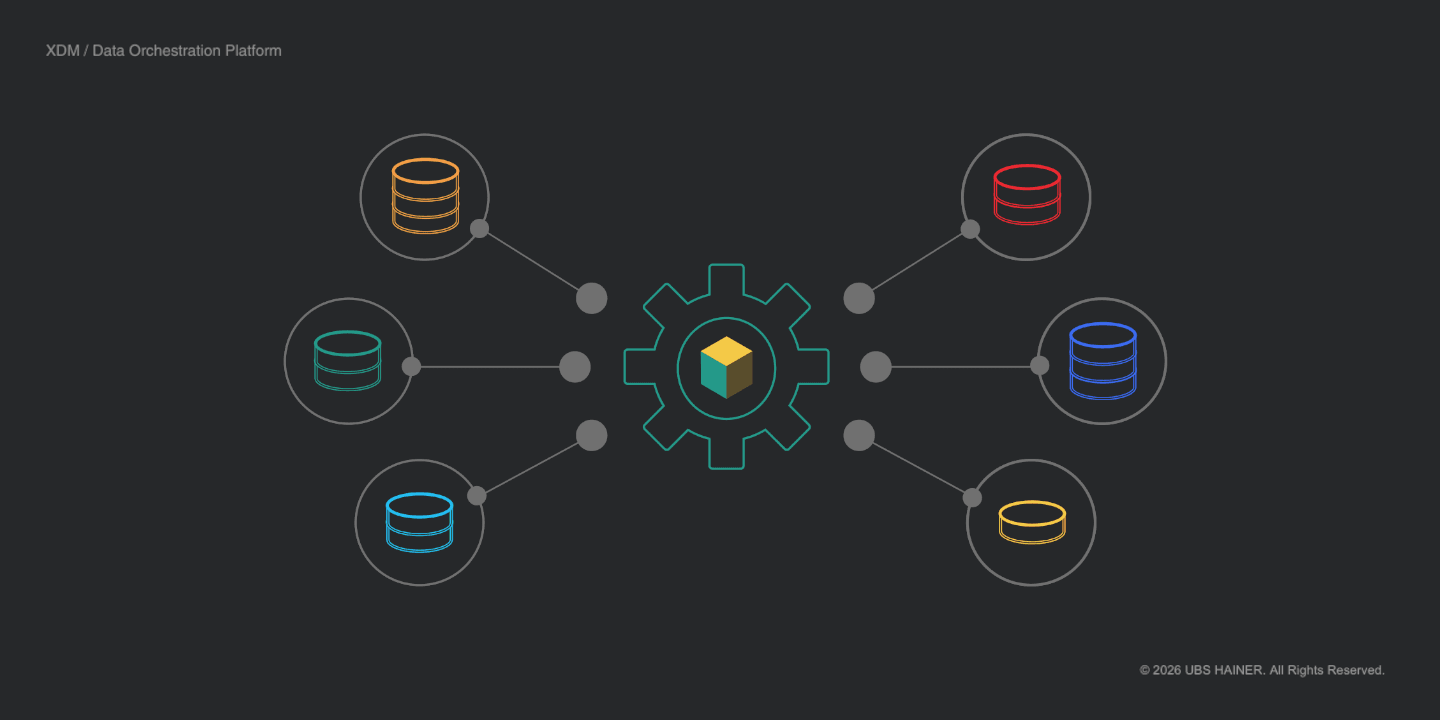
XDM is exactly this approach: a platform that seamlessly supports Db2 z/OS, IMS, and VSAM and centrally orchestrates data provisioning, masking, and governance. Instead of multiple utility processes and JCL procedures, you configure an application model once, define masking rules, and automate everything else.
For mainframe teams, this means in concrete terms:
- Data discovery instead of manually searching for PII
- Deterministic consistency without additional synchronization logic
- Less JCL complexity through central orchestration
- Governance and auditability as standard, not as a special requirement